Are you propping up pipes and conduit on your metal roof with wood blocks, cinderblocks, rubber pads, Unistrut or whatever else you can find? These haphazard and messy assemblies can trap moisture, cause corrosion and leech chemicals onto the roof, voiding its warranty.
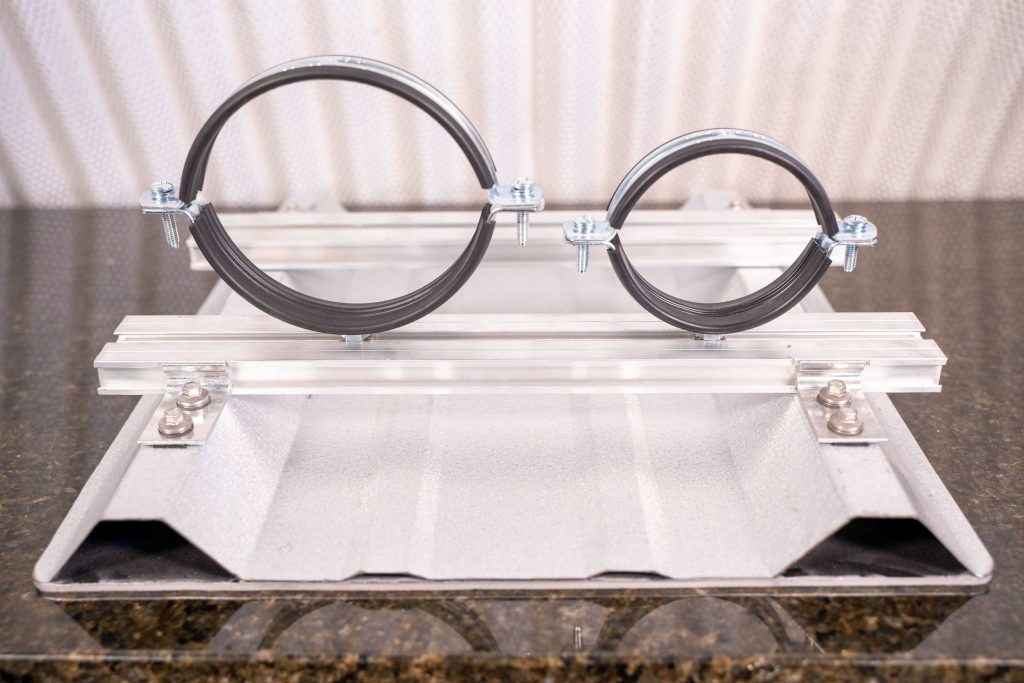
With the CanDuit securement clamp, you can contain piping and conduit in an easy, organized manner with no scratching, corrosion or other damage to your roof.
Multiple Applications
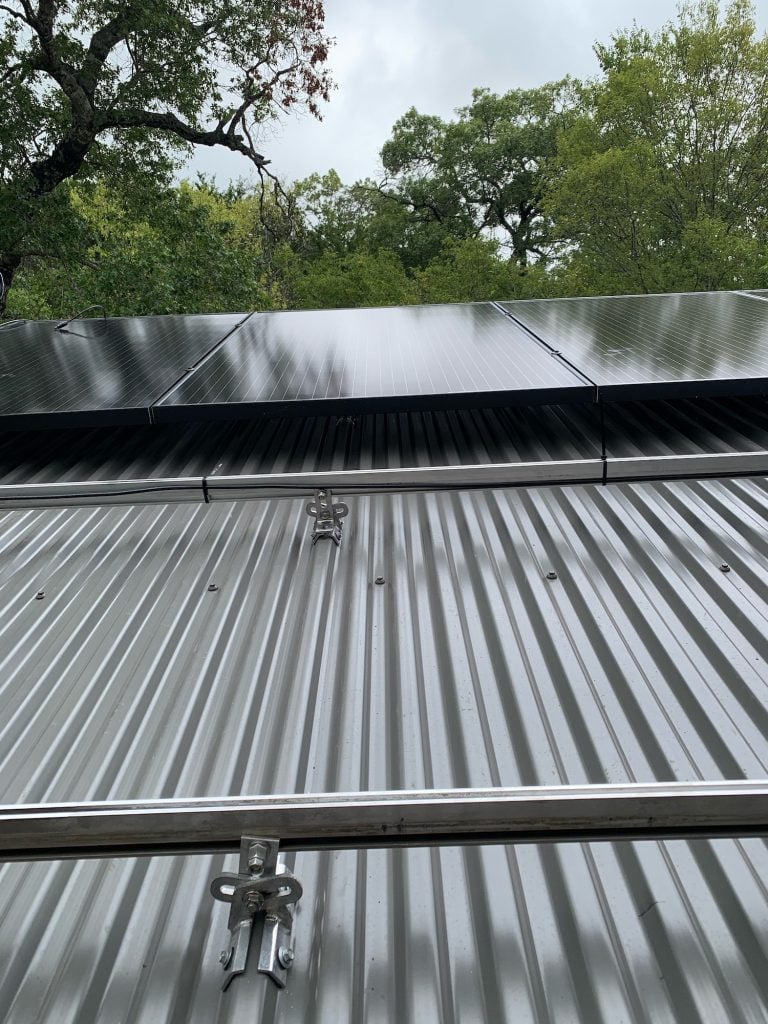
CanDuit works on all types of metal roofs. Simply pair CanDuit with S-5!’s non-penetrating clamps for standing seam roofs, S-5!’s weatherproofed brackets for exposed-fastened roofs or the GRipperFix® utility system. Expertly support piping and conduit in residential and commercial settings for a range of applications:
*Match outer diameter of the pipe/conduit to the adjustability range.
Standing Seam
Exposed-Fastened
Corrugated
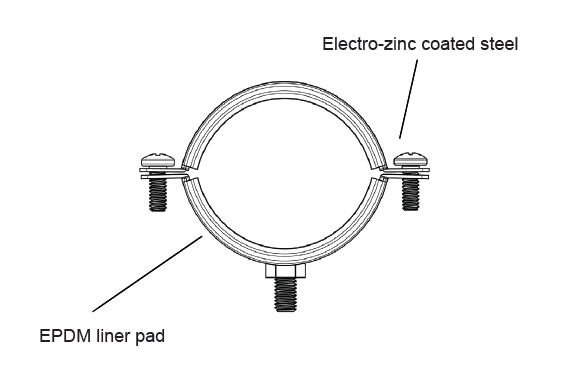
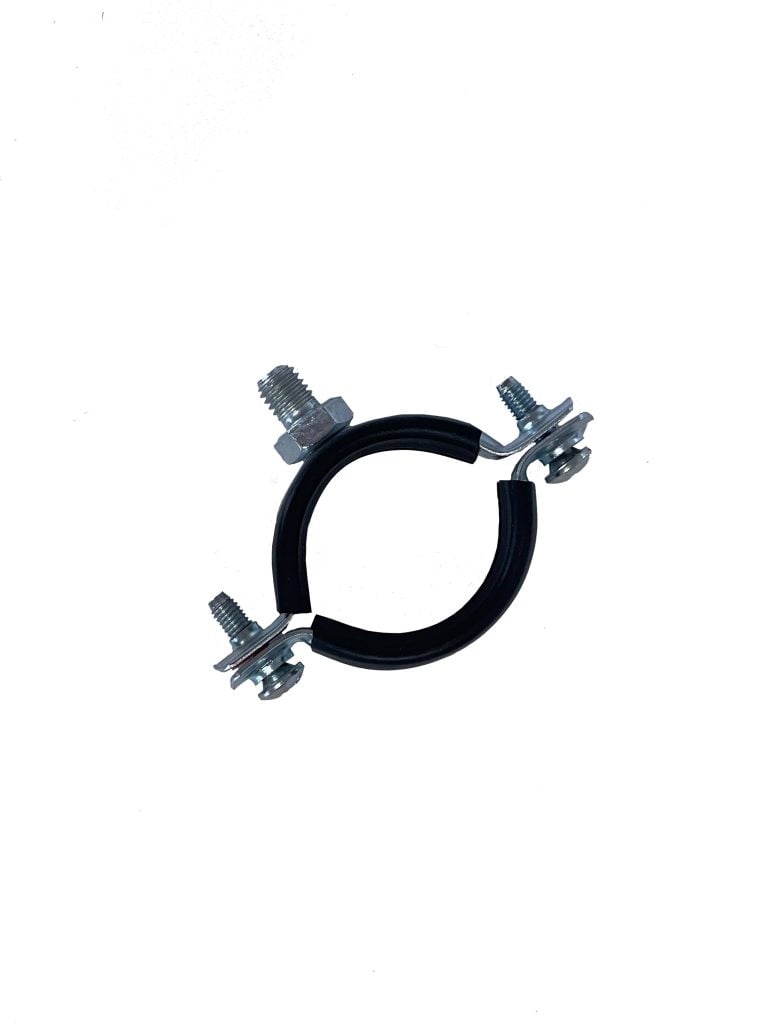
Strap is corrosion-resistant, electro-zinc coated steel; 8-micron minimum thickness.
EPDM liner pad prevents abrasion.
Durable in all environments, CanDuit comes with a 10-year warranty against manufactured defects.
Available in 14 sizes with a pipe outer diameter from .79" (20 mm) to 4.6” (117 mm).
Adjustability within each clamp increases with clamp size to secure most conduit and pipes.
CanDuit’s M8 threaded shaft mounts directly to any S-5! clamp or bracket.
Clamps mount round shapes parallel, transverse or askew to roof seams.
Use with GRipperFix to mount multiple pipes/conduits in groupings or to support a single pipe between two seams. An additional M8 flange nut is required.
Submit your information by clicking the form below, and we’ll get back to you almost immediately.
A question we are asked frequently at S-5! is whether or not our clamps are an approved path for grounding the solar array to the roof. The S-5! PVKIT / S-5! standing seam clamp assembly is a UL2703 listed bonding device. While the listing covers carrying a ground path from PV panel to PV panel, the clamp to the roof panel material is not included in this certification.
On an individual basis, some independent racking companies have worked with certification labs to verify the clamp-to-roof connection and its reliability as a bonding path. For instance, IronRidge has found S-5! clamps provide a reliable bond path between the clamps and the roofing panels beneath the array. This rating is included in their racking systems UL2703 listing. Please see page 4 of the links:
The following suggestions assume a determination has been made that the roof to which the S-5! clamps will be attached is structurally adequate. Any loads imposed on the S-5! clamps will be transferred to the panels. Panel seams must have sufficient flexural strength to carry these loads. Panels must also be adequately attached to the building structure, and the structure must be sufficient to carry these loads. The makers of S-5! clamps make no representations with respect to these variables. It is the responsibility of the user to verify this information or seek assistance from a qualified design professional, if necessary.
The key to frequency and spacing of attachment points for PV is to distribute loads to the metal standing seam panels in a manner consistent with the intended distribution of loads from the roof panels into the building structure. With very few exceptions, the attachment of a single S-5! clamp (even the “Mini”) to the seam will be stronger than a single point of attachment of the seam to the building structure. Hence, the “weak link” is not the S-5! clamp, but the attachment clips that hold the metal panels to the building structure or the beam strength of the roof panel seam itself.
The most conservative approach to the spacing/frequency of PV attachment to the roof is to determine the spacing/frequency of the roof’s attachment to the building structure; then duplicate it at minimum. Determining panel attachment spacing in one axis is very simple: A standing seam panels’ attachment will be made using concealed hold-down clips within the seam area of the panel. So, in that axis, the clip spacing is the same as the seam spacing. The location of the clips along the seam (in the other axis) can be determined by a) consultation with the roof system manufacturer or installer, b) checking from the underside or, c) close examination from the topside along the seam. There will usually be a slight, but detectable, deformation of the seam at the clip location visible from the roof’s topside. Many standing seam roofing systems are installed on “pre-engineered steel” buildings. The attachment spacing in that industry is typically 5’-0” and is readily apparent by inspecting the structural purlins to which the panel clips are attached from the roof underside (interior of the building).
If the panel clips are spaced, for instance, 5′-0″ on center along the seam, then use the 5′-0″ dimension as a maximum spacing for the S-5! clamps. (S-5! clamps may also be spaced at closer centers, but not wider.) When modules are direct-attached (without racking) in landscape orientation, this spacing dimension is dictated by the smallest dimension of the PV frame. Using the roof panel clip spacing as a maximum spacing template for S-5! clamps is a sound practice whether the PV modules are attached directly to S-5! or to a racking system, which is in turn, attached to the S-5! (and panel seams). To evenly distribute loads, it is also necessary for each seam to be involved in the finished assembly. Thus, every time a seam is traversed, it should be attached. Such an attachment scheme should evenly distribute wind loads into the building structure through the panels and their attachment, as intended in the original roof construction assembly.
Please note, these are only suggestions. Wind dynamics are complex, and S-5! advises review by a qualified licensed professional who understands wind effects and metal roof design and construction.
S-5! brackets feature integrated sealant reservoirs to prevent over-compression of the seal and to protect the sealant from UV degradation. No risky, field applied sealants are ever used. No need to source sealant materials. Instead, you get permanence, convenience, maintenance freedom, ease of installation, a complete assembly, and peace of mind.
Double Seal
EPDM factory-seal is used on sheeting-only attached brackets that mount on roof ribs or corrugations out of the drainage plane. This creates a “double-seal” by way of the EPDM washer on the fasteners from above and the pre-applied EPDM on the feet of the bracket from below.
Triple Seal
A watertight, factory-applied, 60-year butyl polymer seal is used on our brackets that attach to the decking or structure in the drainage plane of the roof. This butyl polymer along with the EPDM seal on the fasteners forms what we call a “triple seal”. The first seal is formed by the washer on the fastener from the top side. The second seal is the butyl polymer beneath the feet of the bracket, and the third is formed as the fastener is driven into the substrate, pulling butyl polymer into the threads of the fastener.
Engineered metal buildings have steel purlins. Post-frame buildings generally have wood purlins. Residential and light commercial wood frame construction generally has wood deck.