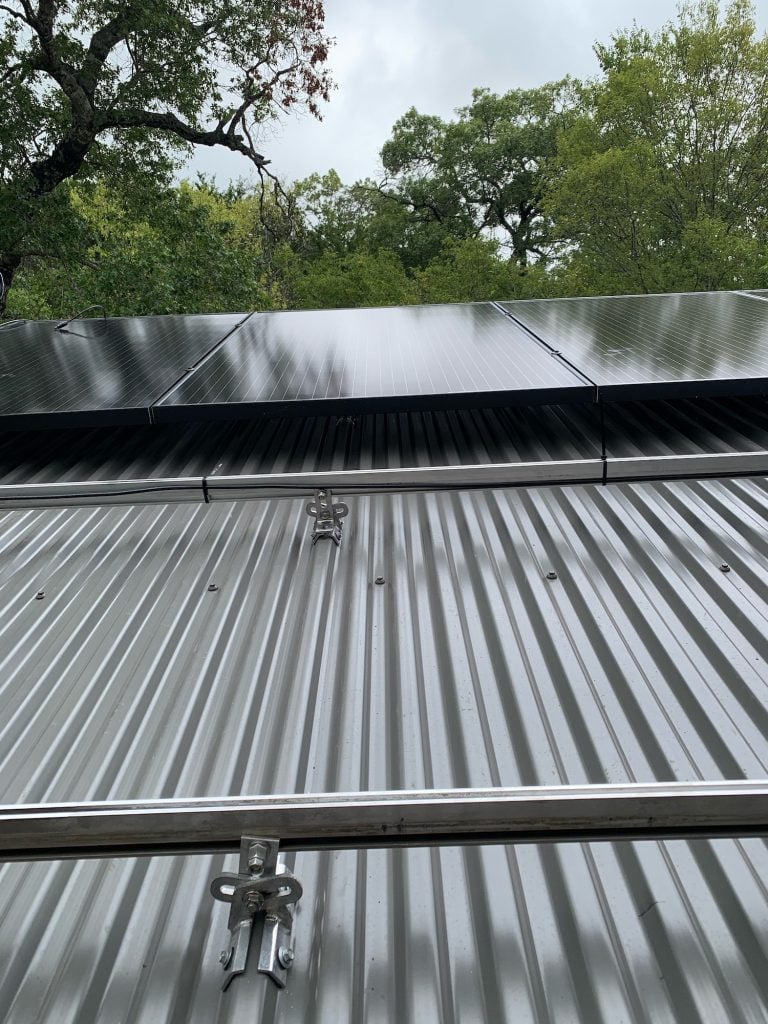
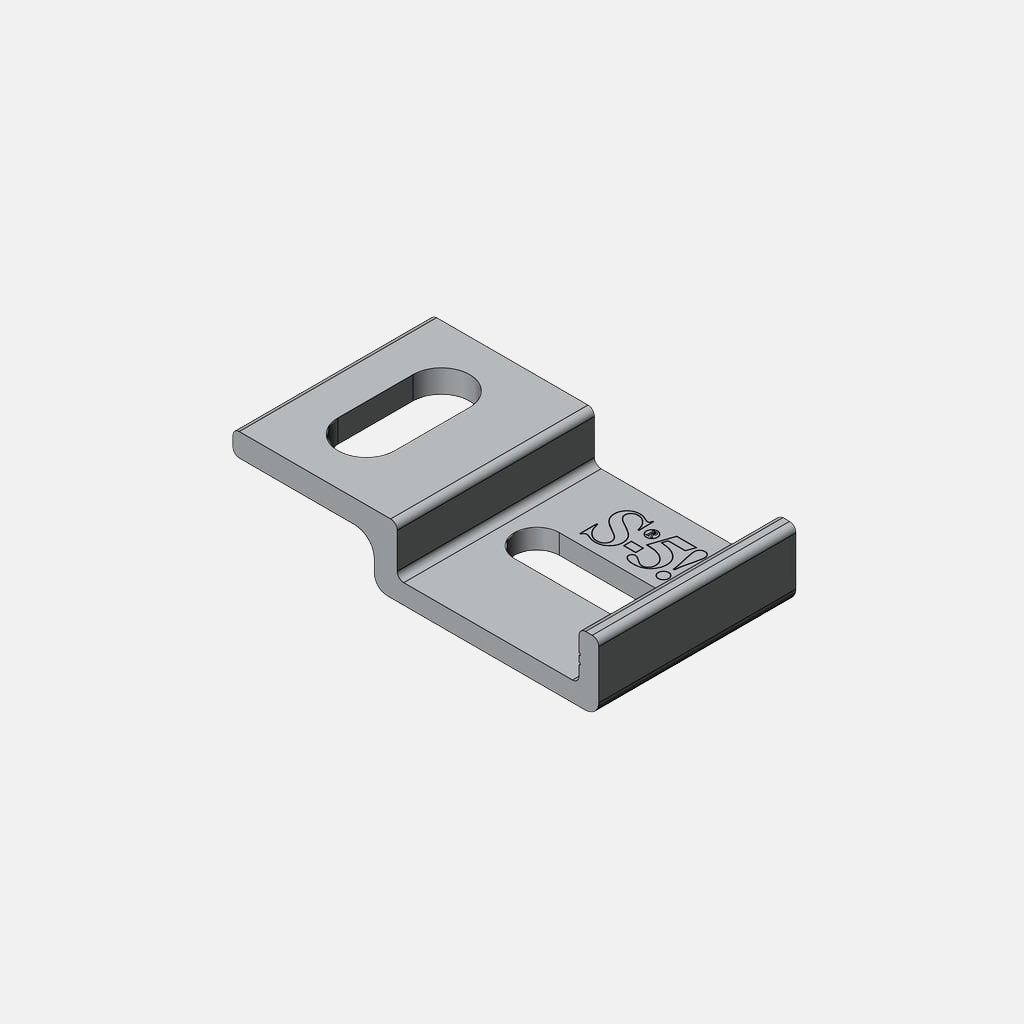
The S-5-FA (“FA” stands for “flange adapter”) can be mounted on any clamp (except brass) to quickly provide a nut-and-bolt connection on a standing seam metal roof (SSMR).
Offering 360° in placement flexibility, the FA is an ideal attachment solution for module-level power electronics, bottom-mount solar rails, walkways and a host of other utility mountings.
Rather than being flat, the FA is a curved shape, providing additional structural stability. The flange features a slotted hole, offering you greater adjustability when mounting.
Stainless steel serrated flange nuts and several bolt sizes are sold separately.
Be sure to check out the many other features on the clamp overview page.
Standing Seam
Exposed Fastened
Attach the flange adapter to any S-5! clamp (except brass) with an M8 bolt. The flange adapter can be oriented as desired. Using an M8 nut and bolt, attach ancillaries to the other slotted hole.
*See more detailed installation instructions in the PDF download below.
*S-5! clamps may be moved in the event of initial misplacement. However, due to the ensuing oxidation process which acts as a natural thread lock, we can express no opinion to the performance of a clamp once it has been removed and reinstalled or the ability to remove the clamp after this process has occurred.
Submit your information by clicking the form below, and we’ll get back to you as soon as possible.
The answer to this question varies with the load direction, the seam profile and gauge thickness, the roof material, and the clamp model. These variables result with a wide range of holding capacities from ±300 lbs (235 kg) to ±4,000 lbs (1800 kg). This is why for critical applications it is important to correctly identify the roof panel, seam type, gauge, etc along with the recommended seam clamp for the specific roof. [ link-- Clamp-to-seam tool] When used on some “applied cap” architectural type seam styles, S-5! may yield low load-to-failure results as compared with integrated seam profiles. Always check our load table to verify correct allowable holding strength on your specific roof type
We perform hundreds of rigorous tensile load tests parallel and normal to the panel seam on various gauges and profiles, the results are tabulated for your convenience here: Load Test Results.
In the parallel load direction, loads that are introduced into the clamp will transfer to the panel’s seam and accumulate to the point of fixity in tension (or compression). Roof panels must be adequately attached to resist these loads. S-5! clamps have been laboratory-tested on various seam types, profiles, and materials for ultimate failure loads parallel to panel seam (“drag” type loads). The ultimate load-to-failure results vary with individual panel profiles and gauges. Watch this video to understand more about testing and why we test. [insert ways we test video].
In the negative normal load direction, with few exceptions, the attachment of a single S-5! clamp (even the “Mini”) to the seam will be stronger than a single point of attachment of the seam to the building structure. The “weak link” then is not the S-5! clamp, but the attachment clips that hold the metal panels to the building structure, or the beam strength of the roof panel seam, itself. Ultimate loads normal to the panel seam (both positive and negative) are more a function of the panel’s beam strength and the failure strength of the panel’s attachment clips than of the holding strength of the S-5! clamp on the panel seam. These values will also change with various attachment spacing.
ASTM standard E-1514-93 for structural standing seam metal roofing requires that roof panels by design must withstand a minimum 200-pound point load in positive (downward) pressure at the panel’s weakest point (the flat of the panel at midspan). The Army Corps of Engineers Technical Instructions for metal roof design spec (TI 809-29) says that the same value should be 300 pounds.
Almost any structural metal panel system will meet and easily exceed the above specifications. The seam area is also much stronger than the panel flat. S-5 attachments transfer positive loads into the panel seam. HVAC units, for example, are mounted successfully in this fashion on numerous projects, utilizing four, six, or eight clamps (bearing points) for a single unit of considerable weight, by distributing the weight of the unit equally over those bearing points so as to maintain a maximum point load within ASTM or ACOE limitations. The building structure must also be designed to support these loads.
You can request our Clamp-to-Seam Gauge Tool from your Authorized S-5! Distributor or directly from S-5! The most common seam geometries are included within this fitment tool.and it is cost-free.
If unsuccessful using the gauge tool, the fastest and easiest way to find the clamp you need is to visit our CLAMP TO SEAM TOOL on our website which takes you through a pictorial process of determining the proper clamp.
When you first get to this page it will ask you if you know the manufacturer and specific profile of your roof or if you don't know these things. Once you have selected the latter option, you will be brought to a page of diagrams that easily let you identify the most common panel seams found in the market today and the corresponding clamps that should fit that seam profile.
In rare cases, the seam may not be found on our clamp-to-seam tool. If that is the case, take some seam identification photos and we can assist you in finding the correct clamp.
Send photos to us using the online support form here.
We would never promote a product that solves one problem on a metal roof, while creating another. The metallic coatings on steel sheet are very thin, but very important for corrosion protection of the base steel. They must not be breached. That’s why we created our custom-designed, stainless steel setscrew. We went to great lengths to have these setscrews custom made to our exact specifications before ever taking our products to market. This special screw has a polished rounded end to prevent damage to the protective coatings of steel sheet. But we didn’t stop there.
These round-point setscrews (or oval-shaped point on one end) are shaped to a specific radius and polished to eliminate abrasion to the panel finish when tensioned. But we didn’t stop there either. We have also performed 2000 hour ASTM B-117 Salt Fog testing on our clamps and setscrews, attached to Galvalume® coated steel panels to prove they maintain perfect metals compatibility and cause no mechanical damage to the coating.
Although standard “cup point” setscrews are lower in cost, they should never be used on coated steel (as some of our competitors may claim). The cup point digs through the coating, creating a corrosion site.
In addition, all our related hardware is non-corrosive, 300 series stainless, not plated steel. The unique S-5! round-point setscrews are always furnished with our clamps because they offer a secure mechanical connection while protecting roof warranties.
For more information on this subject, please visit The Truth about Setscrews.
S-5! has tested more than 500 different roof profiles from over 100 different roof manufacturers. Many panels are identical to those tested although they may be called by a different tradename. Our Clamp-to-Seam Tool searches through all of our known test data, but occasionally the roof nomenclature of a tested panel may not match the nomenclature of your search. Contact [email protected] at our office for further details should this or any other questions arise. If your profile can still not be identified, we will be happy to test it for you—in most cases, free of charge.