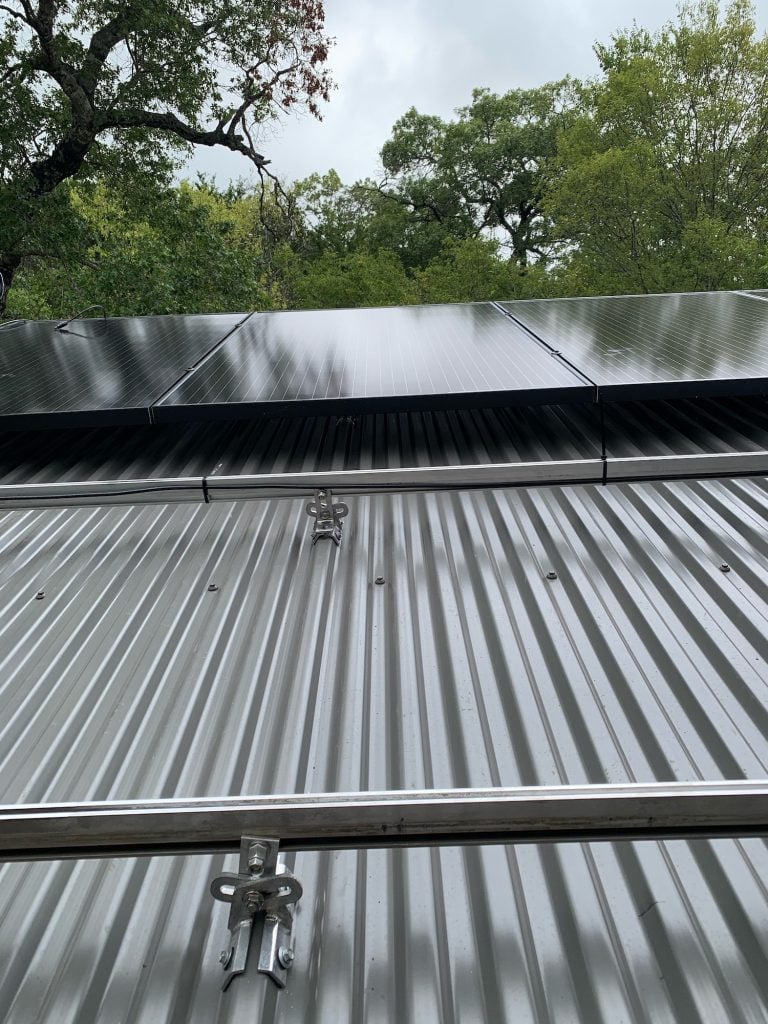
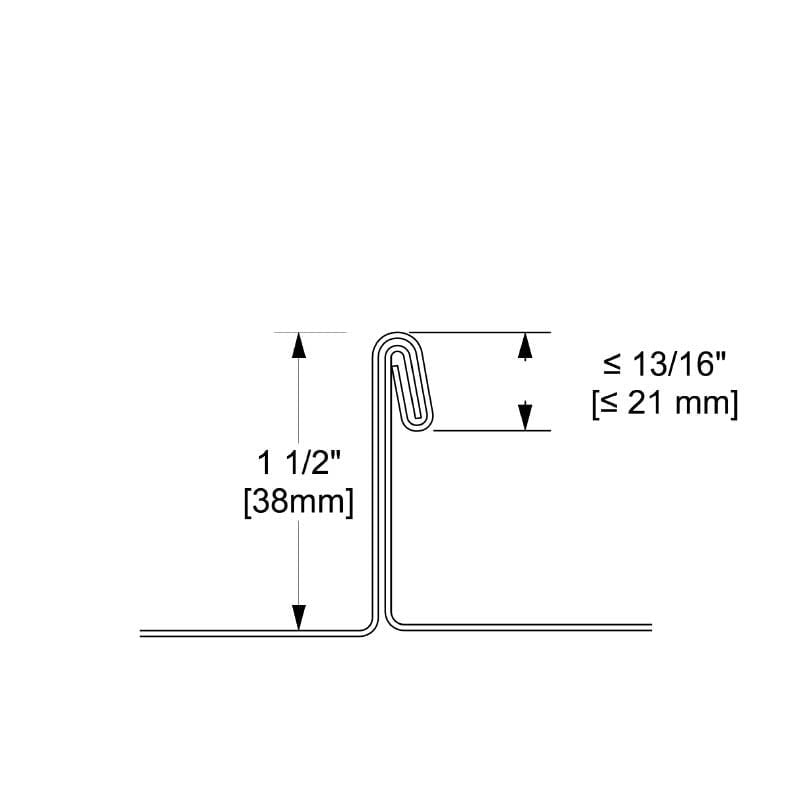
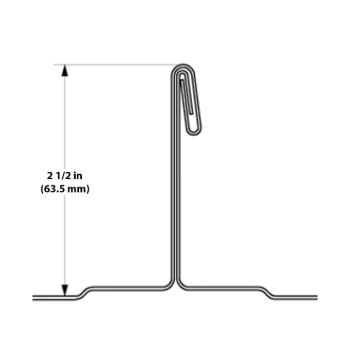
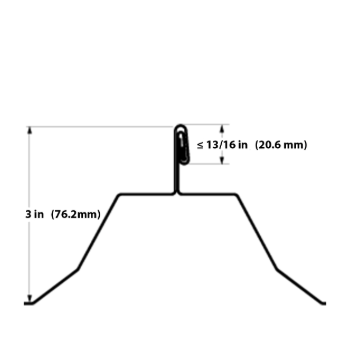
The S-5-V (“V” stands for vertical) is a cost-effective solution for most machine-folded seams in vertical orientation and within certain dimensions. It is non-penetrating and one of our most popular standing seam metal roof clamps.
There may be other S-5! options more appropriate or cost-effective for your specific application.
Minis Available
The V Mini clamp is a more economical solution for lighter-duty attachments where Herculean holding strength is not required.
All standard and Mini clamps undergo rigorous load testing. Negative load normal-to-seam testing (pull-up) is performed on all Mini clamps, and parallel-to-seam testing (drag load) is performed on all standard clamps.
Be sure to check out the many other features on the clamp overview page.
Standing Seam
Place the clamp over the seam at the desired location and tighten the Torx Drive (T-30) setscrews to the specified tension. Then, affix ancillary items using the bolt (provided with standard V clamp; sold separately for the V Mini).
*See more detailed installation instructions in the PDF download below.
*S-5! clamps may be moved in the event of initial misplacement. However, due to the ensuing oxidation process which acts as a natural thread lock, we can express no opinion to the performance of a clamp once it has been removed and reinstalled or the ability to remove the clamp after this process has occurred.
Submit your information by clicking the form below, and we’ll get back to you as soon as possible.
The answer to this question varies with the load direction, the seam profile, the roof material and the clamp model. We have done hundreds of tensile load tests parallel to the panel seam and on various gauges and profiles, and we have tabulated the results for your convenience. See Load Test Results for more information. In this load direction, any loads introduced into the clamp will accumulate into the point of fixity. Panels must be adequately attached to resist these loads.
With very few exceptions, the attachment of a single S-5! clamp (even the “Mini”) to the seam will be stronger than a single point of attachment of the seam to the building structure. Hence, the “weak link” is not the S-5! clamp, but the attachment clips that hold the metal panels to the building structure or the beam strength of the roof panel seam, itself. Ultimate loads normal to the panel seam (both positive and negative) are more a function of the panel’s beam strength and the failure strength of the panel’s attachment clips than of the holding strength of the S-5! clamp on the panel seam. These values will also change with various attachment spacing.
ASTM standard E-1514-93 for structural standing seam metal roofing states that panels must withstand a minimum 200-pound point load in positive (downward) pressure at the panel’s weakest point (the flat of the panel). The Army Corps of Engineers Technical Instructions for metal roof design spec (TI 809-29) says that the same value should be 300 pounds.
Almost any structural metal panel system will meet the above specifications easily. Of course, the seam area is also much stronger than the panel flat. Hence, as a general rule, 300-pound positive point loads on the panel seam (above an S-5! clamp) should do the panel no harm. HVAC units have been mounted in this fashion on numerous projects, utilizing four, six or eight clamps for a single unit of considerable weight and dividing the weight of the unit evenly over those point loads. Of course, the building structure must also be designed for these loads.
S-5! clamps have been laboratory tested on various seam types, profiles and materials for ultimate failure loads parallel to panel seam (“drag” type loads). The ultimate load-to-failure results vary with individual panel profiles and gauges. When used on some “applied cap” architectural type seam styles, for example, S-5! may yield low load-to-failure results and may therefore be unsuitable.
Also, keep in mind the setscrews, which make a small dimple in the panel seam, optimizing holding strength, are normally tensioned to 115 inch-pounds for test purposes. This is because the tools normal to the trade are rated at this tightening torque. But, there are some exceptions to this rule. On some profiles and gauges in steel, screw tension of 115 inch-pounds will not adequately dimple the panel seam. In such cases, load-to-failure values would be rather low but for increasing the screw tension. For this reason, the tests are run with higher screw tensions on some profiles. On the other hand, there are very few seams on which the clamp screw engages only two thicknesses of sheet metal. When such material is thin-gauge aluminum or titanium-zinc, the setscrew may pierce through at normal tensions of 115 inch-pounds. For that reason, such seams are tested at lower set screw tensions. Regardless of application, appropriate factors of safety should always be applied, and screw tension verified when relying on these test results.
Our standard test procedures are to test the Mini (one setscrew) clamps with negative load normal to seam and standard (two setscrew) clamps with load parallel to seam. We have performed numerous parallel-to-seam datum tests on Mini clamps and concluded the Mini clamp is capable of (conservatively) obtaining at least ½ the strength of the standard clamps. In fact, the majority of the datum testing indicates the strength of a Mini is closer to 2/3 the strength of a standard clamp.
Should the load application pulling load parallel to seam be critical to your application, we suggest using the standard (two setscrew) design.
The following suggestions assume a determination has been made that the roof to which the S-5! clamps will be attached is structurally adequate. Any loads imposed on the S-5! clamps will be transferred to the panels. Panel seams must have sufficient flexural strength to carry these loads. Panels must also be adequately attached to the building structure, and the structure must be sufficient to carry these loads. The makers of S-5! clamps make no representations with respect to these variables. It is the responsibility of the user to verify this information or seek assistance from a qualified design professional, if necessary.
The key to frequency and spacing of attachment points for PV is to distribute loads to the metal standing seam panels in a manner consistent with the intended distribution of loads from the roof panels into the building structure. With very few exceptions, the attachment of a single S-5! clamp (even the “Mini”) to the seam will be stronger than a single point of attachment of the seam to the building structure. Hence, the “weak link” is not the S-5! clamp, but the attachment clips that hold the metal panels to the building structure or the beam strength of the roof panel seam itself.
The most conservative approach to the spacing/frequency of PV attachment to the roof is to determine the spacing/frequency of the roof’s attachment to the building structure; then duplicate it at minimum. Determining panel attachment spacing in one axis is very simple: A standing seam panels’ attachment will be made using concealed hold-down clips within the seam area of the panel. So, in that axis, the clip spacing is the same as the seam spacing. The location of the clips along the seam (in the other axis) can be determined by a) consultation with the roof system manufacturer or installer, b) checking from the underside or, c) close examination from the topside along the seam. There will usually be a slight, but detectable, deformation of the seam at the clip location visible from the roof’s topside. Many standing seam roofing systems are installed on “pre-engineered steel” buildings. The attachment spacing in that industry is typically 5’-0” and is readily apparent by inspecting the structural purlins to which the panel clips are attached from the roof underside (interior of the building).
If the panel clips are spaced, for instance, 5′-0″ on center along the seam, then use the 5′-0″ dimension as a maximum spacing for the S-5! clamps. (S-5! clamps may also be spaced at closer centers, but not wider.) When modules are direct-attached (without racking) in landscape orientation, this spacing dimension is dictated by the smallest dimension of the PV frame. Using the roof panel clip spacing as a maximum spacing template for S-5! clamps is a sound practice whether the PV modules are attached directly to S-5! or to a racking system, which is in turn, attached to the S-5! (and panel seams). To evenly distribute loads, it is also necessary for each seam to be involved in the finished assembly. Thus, every time a seam is traversed, it should be attached. Such an attachment scheme should evenly distribute wind loads into the building structure through the panels and their attachment, as intended in the original roof construction assembly.
Please note, these are only suggestions. Wind dynamics are complex, and S-5! advises review by a qualified licensed professional who understands wind effects and metal roof design and construction.
S-5! clamps will not fit on face-fastened trapezoidal rib or corrugated type panels. While S-5! clamps won't work on thru-fastened roofs, we do offer bracket products for them. You can find those here: S-5! Brackets. Also, the bracket products will not fit on most “batten” seam type panels, except for the traditional batten seams folded joints as demonstrated below in green. Any time there is a folded seam, we can usually attach a clamp to it. A great way to know if we have a product for your roof is to determine the roof profile with our "Clamp-to-Seam Tool."